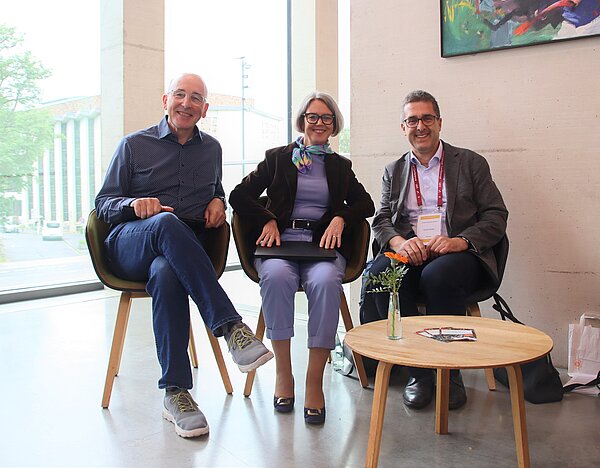
The international phase III NSABP-B-59/GBG-96-GeparDouze trial, involving Goethe University Frankfurt, Frankfurt University Hospital and the University Cancer Center (UCT) Frankfurt-Marburg, investigated whether the immune checkpoint inhibitor atezolizumab could improve treatment outcomes in early triple-negative breast cancer. The results of the study have now been published in the renowned journal Nature Medicine.
NEU-ISENBURG/FRANKFURT/MARBURG. Triple-negative breast cancer (TNBC) is considered the most aggressive breast cancer subtype and is associated with an increased risk of recurrence. Because TNBC lacks hormone receptors (estrogen and progesterone) and human epidermal growth factor receptor 2 (HER2), therapies targeting these receptors are largely ineffective. At the same time, TNBC is characterized by an activated tumor immune microenvironment. Immune checkpoint inhibitors therefore represent an important therapeutic approach that can be used in addition to chemotherapy. They are intended to enhance the immune response against tumor cells by preventing tumor-infiltrating lymphocytes (TILs) from recognizing cancer cells as “self.”
A large international phase III trial investigated whether the immune checkpoint inhibitor atezolizumab could improve treatment outcomes in early TNBC. The results of the NSABP-B-59/GBG-96-GeparDouze trial have now been published in the highly regarded peer-reviewed journal Nature Medicine. They show that, in the overall study population, the addition of immunotherapy did not result in a statistically significant improvement in event-free survival. However, extensive biomarker and subgroup analyses suggest that certain patient groups may derive greater benefit.
Breast cancer research from Frankfurt and Marburg – internationally connected
The first author of the publication is Prof. Dr. Sibylle Loibl, who has been Professor of Innovative Systemic Therapy of Breast Cancer at Goethe University Frankfurt since 2025. Also involved in the study are Prof. Dr. Thomas Karn, Director of the Translational Research Laboratory at the Department of Gynecology at Frankfurt University Hospital, and Prof. Dr. Carsten Denkert, Director of the Institute of Pathology at Philipps University Marburg and co-senior author of the publication.
Prof. Loibl and Prof. Denkert are also members of the University Cancer Center (UCT) Frankfurt-Marburg, one of 14 cancer centers in Germany designated and funded by the German Cancer Aid as an “Oncological Center of Excellence.”
A total of 1,550 patients from Germany, the United States, Canada and Spain with stage II or III TNBC participated in the randomized, double-blind, placebo-controlled trial. Before surgery, they received standard chemotherapy in combination with either atezolizumab or placebo. After surgery, the assigned treatment was continued, resulting in a total study treatment duration of one year.
The trial was jointly conducted by the NSABP Foundation, Pittsburgh, and GBG Forschungs GmbH, Neu-Isenburg, in close collaboration with Genentech/Roche, which also provided financial support for the clinical trial. The biomarker research received funding from the European Commission (ONCOBIOME H2020), the Federal Ministry of Research, Technology and Space (SATURN3), and the H.W. & J. Hector Foundation.
TNBC is not a uniform disease
After a median follow-up of 46.9 months, the four-year event-free survival rate was 85.2% with atezolizumab and 81.9% with placebo. This difference did not reach the prespecified threshold for statistical significance. No significant benefit was observed for overall survival at four years either.
At the same time, atezolizumab increased the rate of pathological complete response, defined as the complete disappearance of invasive tumor cells from the breast and lymph nodes at the time of surgery, from 57.0% to 63.3%.
However, immunotherapy was also associated with a higher burden of immune-related adverse events and more frequent discontinuation of study treatment. This further highlights the importance of identifying which patients are most likely to benefit from this treatment.
“The results show that immunotherapy with atezolizumab is not equally suitable for all patients with triple-negative breast cancer,” says Prof. Loibl. “The key will be to identify biological characteristics that allow us to recognize those patients who can truly expect a clinically meaningful benefit.”
Biomarkers could enable more targeted therapy in the future
The accompanying translational analyses conducted at the Institute of Pathology at Philipps University Marburg, under the leadership of Prof. Denkert, provide further evidence of the heterogeneity of TNBC.
In particular, patients with clinical lymph node involvement and high levels of tumor-infiltrating lymphocytes (TILs) in the breast tumor showed a signal for greater benefit from atezolizumab. Analyses of gene signatures also suggest that molecular subgroups of TNBC may respond differently to immunotherapy. Tumors with an immune-activated microenvironment appear particularly promising for further investigation.
The findings underscore that TNBC is not a uniform disease. In the future, combining clinical risk characteristics, TIL assessment and molecular subtyping could help to identify patients who are most likely to benefit from immunotherapy, enabling a more targeted use of immune checkpoint inhibitors while potentially avoiding unnecessary treatment-related adverse events.
Publication: Sibylle Loibl, Gong Tang, Valentina Nekljudova, Priya Rastogi, Sivaramakrishna Rachakonda, Mattea Reinisch, Joshua Acosta, Andreas Schneeweiss, Christie Hilton, Sabine Seiler, Rohit Bhargava, Thomas Karn, Patricia Cortazar, Fernando Moreno, Jay Andersen, Stephani Christensen, Peter Klare, Sujatha Murali, Serafín Morales, Jens Huober, Jean-François Boileau, Álvaro Rodríguez-Lescure, Dominique Boudreau, Peter J. Polewski, Julia Teply-Szymanski, João Mouta, Eleftherios P. Mamounas, Carsten Denkert, Norman Wolmark, and Charles E. Geyer, Jr. Atezolizumab in early triple negative breast cancer: the randomized phase 3 NSABP-B59/GeparDouze trial. Nature Medicine (2026). Doi: 10.1038/s41591-026-04565-6